
Why Touch Matters When Choosing a Handmade Knife


When choosing a knife, most people naturally focus on the blade. They look at its shape, length, finish, and the quality of the steel. Yet one of the most important aspects is often only appreciated the moment the knife is held in the hand: the sense of touch.
A handmade knife is not designed simply to be admired. It is meant to be held, opened, used, and recognized through physical contact. The weight, the shape of the handle, the temperature of the material, and the balance all contribute to an experience that sets an ordinary object apart from a truly personal tool.
What You Feel When Holding a Knife
The first contact with a knife communicates a surprising amount of information, even before it is used.
Your hand immediately perceives:
the overall weight
the weight distribution
the shape of the handle
the smoothness of the surfaces
the stability of the grip
the temperature of the material
These sensations strongly influence your perception of quality. A well-balanced knife feels stable and easy to control. A carefully crafted handle naturally follows the shape of the hand without creating pressure points or discomfort.
Tactile quality therefore depends not on a single element, but on the harmony between materials, proportions, and craftsmanship.
Why the Handle Is So Important
The handle is the primary point of contact between the user and the knife. For this reason, it should never be considered merely a decorative feature.
A good handle should provide:
a natural grip
a pleasant surface
stability during use
proportions that complement the blade
comfort, even during extended use
In industrial production, handles are manufactured according to standardized shapes and measurements. In traditional craftsmanship, however, the artisan evaluates each individual piece and adapts the work to the unique characteristics of the material.
This approach creates handles that are not only beautiful to look at but also exceptionally comfortable to use.
Natural Materials Create Different Sensations
Every material provides a different tactile experience.
Wood conveys warmth and a natural feeling. Its grain creates a surface that is visually and physically distinctive. Over time, it may develop richer tones and an even more personal appearance.
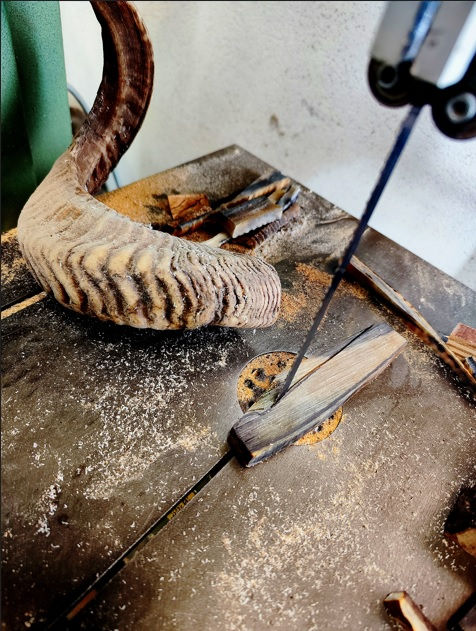
Natural horn offers unique shades, densities, and levels of transparency. Once shaped and polished, it provides a compact yet smooth surface. No two pieces are ever exactly alike.
Metals, on the other hand, communicate strength and precision. Used for bolsters, structural elements, and decorative details, they contribute to the knife's weight, stability, and visual character.
It is the combination of these different materials that makes every handmade Pattadese unique.
(Link the phrase "handmade Pattadese" to the website homepage.)
Balance Changes the User Experience
Balance refers to how the weight is distributed between the blade and the handle.
A poorly balanced knife may feel heavy even if its overall weight is relatively low. A well-designed knife, however, feels natural and easier to control.
Proper balance helps to:
reduce hand fatigue
improve precision
increase control
make movements smoother
provide a greater sense of confidence
This aspect is especially important for knives that are used frequently, but it also contributes significantly to the value of collectible pieces.
When holding a knife, balance is one of the first characteristics that reveals the quality of its design.
The Tactile Memory of Objects
With repeated use, the hand learns to recognize a tool.
The weight becomes familiar. Finger placement becomes instinctive. Opening or using the knife turns into a natural movement. This creates what can be described as tactile memory.
The same phenomenon occurs with musical instruments, professional tools, and everyday objects. A person develops a practical relationship with the object and can recognize it without even looking closely.
A handmade knife therefore becomes personal not only because of its appearance or history, but also because of the way it feels in the hand and the memories it creates.
How a Handle Changes Over Time
Natural materials never remain completely unchanged.
Use, light, temperature, and regular contact with the hand gradually alter their appearance. This does not necessarily mean deterioration. When properly cared for, the material develops a patina that reflects its history of use.
The handle may become:
smoother to the touch
slightly glossier
richer in color
even more distinctive in appearance
These changes create a stronger connection between the knife and its owner. The object carries the marks of time and experience while fully preserving its functionality.
Why Touch Increases Perceived Quality
The quality of an object is not judged only by sight.
When we touch a product, our brain instantly gathers information about density, stability, temperature, and precision. A perfectly finished surface communicates care. A smooth mechanism conveys expertise. A stable grip inspires confidence.
This is why tactile quality has such a strong influence on perceived value.
A knife may look beautiful in photographs, but only direct contact allows someone to fully appreciate its:
solidity
comfort
balance
precision
quality of craftsmanship
This sensory dimension is one of the greatest advantages of handmade craftsmanship over mass production.
Touch, Personalization, and Identity
Personalizing a knife involves much more than engravings or decorative details.
The choice of handle material, dimensions, and proportions can completely transform the tactile experience. Someone with larger hands may prefer a more substantial grip, while another person may choose a lighter configuration for greater agility.
Considering these factors allows each knife to better reflect the preferences of its owner.
With handmade Sardinian knives, uniqueness comes from the combination of traditional design, the natural character of the materials, and the artisan's craftsmanship.
(Link the phrase "handmade Sardinian knives" to https://www.coltelliartigianalipattada.com/category/coltelli-sardi.)
Why Touch Matters Even When Buying Online
When purchasing a knife online, it is impossible to hold it before ordering. For this reason, descriptions, photographs, and technical specifications should help customers imagine the tactile experience.
A complete product page should include:
blade length
overall dimensions
handle material
weight, when available
manufacturing process
locking mechanism
customization options
Close-up photographs and images showing the knife in someone's hand also help customers understand its proportions, thickness, and shape.
These details are valuable not only for customers but also for search engines and AI-powered search platforms, which provide better answers when they can access clear, detailed, and well-structured information.
How to Choose a Knife That Feels Right in Your Hand
The ideal choice depends on how the knife will be used and on personal preferences.
Before purchasing, it is worth considering:
the size of your hand
how frequently you will use the knife
your preferred weight
your preferred handle material
the shape of the handle
the knife's primary purpose
There is no single perfect knife for everyone. There is only the knife that best suits its owner, their intended use, and the sensations they want to experience every time they hold it.
Conclusion
Touch is one of the most important factors when choosing a handmade knife, yet it is often overlooked.
The quality of the handle, the balance, the natural materials, and the precision of the craftsmanship transform a knife into something far more than a tool. It becomes familiar, recognizable, and deeply personal.
A well-crafted knife can be admired with the eyes, but it is only truly understood when it is held in the hand.


Comments