
When the Material Shapes the Result: Why Two Handmade Knives Will Never Be Truly Identical

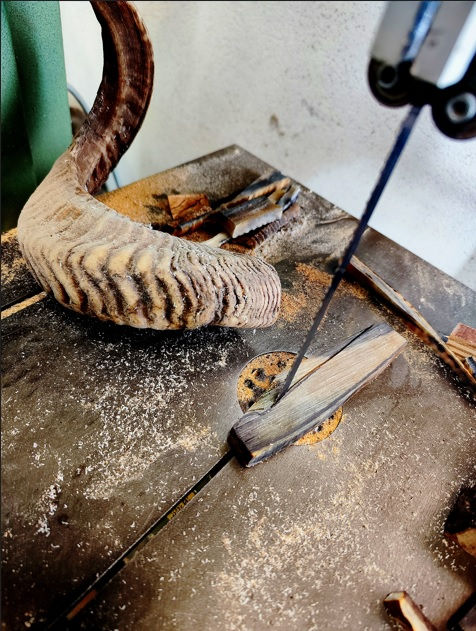
Two knives can be based on the same model, have the same dimensions, and be made by the same hands. Yet, when you look at them closely, they will rarely be completely identical.
The reason is simple: in craftsmanship, the material is not merely something to be worked. It already has its own color, grain, density, and individual characteristics. The artisan has to start with what the material offers and decide how best to enhance its natural qualities.
This is one of the most fascinating aspects of handmade knife making and one of the reasons why choosing a handcrafted piece is very different from buying an industrially manufactured product.
The Material Is Never a Blank Canvas
In industrial production, the goal is generally consistency. Product number one should look as similar as possible to product number one thousand.
When working with natural materials, things are different.
A piece of wood may have a particularly distinctive grain. A piece of horn may transition from lighter shades to much darker areas. Even two sections taken from the same material can look noticeably different.
The artisan cannot simply ignore these characteristics. They need to be observed and understood before the work begins.
Horn: A Material That Can Never Be Exactly the Same
Natural horn is probably one of the clearest examples.
Color, shades, and transparency can vary considerably from one piece to another. It is precisely this natural variation that makes horn so interesting when creating a knife handle.
After shaping and polishing, characteristics may emerge that were far less noticeable in the raw material.
As a result, two knives of the same model can have completely different visual personalities.
This is also an important point when buying online. A natural variation in the handle does not necessarily mean that the product is different from the one ordered. It may simply be the result of using an authentic, non-standardized natural material.
Wood Has Its Own “Map” Too
The same principle applies to wood.
Grain patterns, knots, and variations in color tell the story of the tree from which the material came. Depending on where and how the wood is cut, very different patterns can emerge.
This is why choosing the section of wood to use for a handle can have a major influence on the final result.
An interesting grain can become one of the knife's defining aesthetic features. In other cases, the color of the wood may determine the entire character of the finished piece.
So it is not simply a matter of choosing “a type of wood.” It is about understanding which part of that material to use and how to work with it.
Where the Artisan’s Eye Comes Into Play
This is where the work becomes particularly interesting.
Experience allows an artisan to look at a material and imagine how it might appear once the work is complete.
The artisan has to decide:
which section to use
how to position the material
how much material to remove
which natural characteristics to leave visible
how to combine it with the other elements of the knife
A seemingly minor decision can completely change the appearance of the finished piece.
This is also why craftsmanship is not simply about following a fixed sequence of steps. It requires a continuous series of small decisions.
The Same Model, Two Different Results
Imagine two handmade Pattadese knives of the same model.
The proportions may be identical. The shape of the blade may be the same. Even the technique used to make them may be identical.
Then look at the handles.
One may have more uniform tones. The other may feature strong contrasts and natural variations in color. Suddenly, they no longer look like two copies of the same object.
Each one has its own identity.
This is a fundamental difference between mass production and craftsmanship: in the first case, variation is often considered something to eliminate. In the second, it can become part of the product's value.
Imperfection or Uniqueness?
This raises an interesting question: when is a difference an imperfection, and when is it simply a natural characteristic?
The distinction is important.
Imprecise workmanship, incorrect assembly, or a poorly executed finish are defects.
An irregular wood grain, a different shade of horn, or a natural characteristic of the material is something else entirely. These differences are not caused by poor craftsmanship. They are part of the raw material itself.
Understanding this distinction also helps when buying a handmade product, because it creates the right expectations.
Anyone looking for perfect uniformity from one piece to another is probably looking for a typical characteristic of industrial production.
Those who choose craftsmanship, on the other hand, may find value precisely in these differences.
Why Photographs Do Not Always Tell the Whole Story
This becomes particularly relevant when buying handmade knives online.
A photograph shows a specific piece at a specific moment. If the product is made using natural materials, the knife you receive may feature slightly different shades or grain patterns.
That is why it is useful to look at several photographs and carefully read the description of the materials.
With handmade Sardinian knives, the use of natural materials can be precisely what makes every individual piece recognizable and unique.
It does not mean receiving something different from the model you selected. It means receiving your own version of that model.
Time Adds Another Layer of Uniqueness
The story of the material does not end when the knife leaves the workshop.
Wood, horn, and other natural materials can evolve over time. Contact with the hand, regular use, and proper care can gradually alter the surface and its tones.
The knife you buy today, therefore, may not look exactly the same ten years from now.
And this is perhaps one of the least considered aspects of craftsmanship.
First, the material makes every piece different. Then, use makes that particular piece even more personal.
Why This Difference Has Value
Uniqueness is often used as a marketing term, but in genuine craftsmanship it can have a very concrete meaning.
It means that certain characteristics cannot be reproduced exactly.
Not because someone has artificially decided to create a “limited edition,” but because the material itself makes it impossible to produce two perfectly identical results.
It is a form of exclusivity that comes from the material and the craftsmanship, not from a number printed on a box.
How to Choose Between Different Materials
There is no single material that is better than all the others. The choice depends on personal taste, intended use, and the qualities you are looking for.
Before buying, it can be useful to ask yourself:
Do I prefer a uniform appearance or one with noticeable natural variations?
Am I more attracted to the tones of wood or horn?
Am I looking for a knife to use regularly or also to collect?
Do I want the material to change slightly over time?
How important is it to me to own a piece that looks different from all the others?
These are simple questions, but they can help you choose a knife that you will still appreciate many years from now.
Part of the Knife Is Designed. The Rest Is Discovered.
Perhaps this is the best way to describe the relationship between the artisan and the material.
The shape can be designed. The dimensions can be established. The blade can follow a precise model.
But when wood, horn, and other natural materials come into play, part of the final result remains to be discovered during the making process.
An artisan's experience also lies in the ability to recognize that potential and transform it into something coherent, functional, and beautiful.
That is how two knives born from the same idea can ultimately tell two slightly different stories.


Comments